The torrid zone
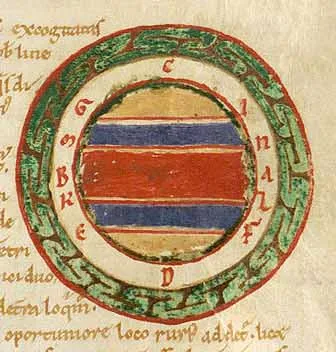
In the center of the magnificent Cathedral of Seville, there is a garden filled with rows of orange trees. If you were to stand among them, you might miss an unassuming iron door tucked into a corner of the courtyard. It leads to a remarkable library called the Biblioteca Colombina. Its archives contain many of Christopher Columbus' own letters and possessions. Among them is one of the main geographical reference books Columbus used while planning his voyages. Called the Imago Mundi, it is an unassuming leather-bound tome, first compiled in 1410 by the French cardinal Pierre d'Ailly.
On one page, d'Ailly describes how the globe is split into three climate bands - one frigid, one temperate, and a "torrid zone" - what we would now call the tropics. Curiously, though, he states that these southern regions are completely "uninhabitable on account of excess heat."
What should we make of this? The answer lies in an unexpected time and place: the last years of the Roman Republic.
I. The dream of Scipio
Around 60 BC three men came to dominate Roman politics: Pompey, Crassus, and Caesar. This famous partnership, now known as the First Triumvirate, might have had a fourth member - Cicero, former consul and eminent writer-statesman. Caesar appears to have inquired with Cicero about joining the alliance, but Cicero refused, seeing it as a threat to the Republic. After all, he was that democratic hero who overthrew a conspiracy against the Senate, and summarily executed the conspirators without a trial.
But by refusing the letter, Cicero had formally cast his lot against the ascending Triumvirate. To Caesar and company, he was now an enemy. In 58 BC a series of sly political moves resulted in the opportunistic populist Clodius passing a series of laws known as the leges Clodiae - among them, a directive to exile anyone who had executed Roman citizens without a trial. This was clearly aimed at Cicero. Caesar had succeeded in removing a political opponent while retaining plausible deniability, and Cicero was exiled.
Distraught and dogged by leering crowds, Cicero's pleas to the Senate fell on deaf ears. He fled in exile to Thessalonica, where he sank into a deep depression. Though he was eventually recalled by the Senate in 57 BC, his political authority diminished as he warily watched what would turn out to be the last years of the Roman Republic. During this time he began to pen a dialogue on politics called De re publica (On the Republic). The work only survives in fragments and quotations, and of the sixth and final book only one passage remains: a bizarre, almost psychedelic work entitled Somnium Scipionis, or the Dream of Scipio.
The passage is written from the perspective of Scipio Aemilianus, hero of the Third Punic War, who had lived a century prior but clearly had a great admirer in Cicero. Aemilianus had been having a conversation about Scipio Africanus, his adoptive grandfather who famously defeated Hannibal in the Second Punic War. As he drifts off to sleep, Africanus appears to him:
...There appeared to me Africanus, in that form which was more familiar to me from his picture than from his person. When I recognised him, I shuddered, I assure you, but he said: "Be of good courage and banish fear, my Scipio, and record what I shall say."1
Africanus proceeds to guide Aemilianus into the heavens, where he indicates from a bird's-eye view the Roman view of the universe: a series of nested spheres vibrating with divine music, Earth at the center. From their lofty perch the elder Scipio points out the smallness of human affairs in the scale of the universe. But the younger Scipio's hungry eyes continue to wander towards Earth.
"I see," said Africanus, "that you are even now regarding the abode and habitation of mankind...For what renown among men, or what glory worth the seeking, can you acquire? You see that on the earth only scattered and narrow plots are inhabited...some [people] even [live] at the opposite point of the earth to you; and from these, at any rate, you can expect no glory.
Cicero alludes here to the Antipodeans, a people believed in classical times to reside in the southern hemisphere as a direct reflection of Europeans in the northern inhabitable zone. St. Augustine would later refute their existence, citing the absurdity "that some men might have taken ship and traversed the whole wide ocean, and crossed from this side of the world to the other."2
For all the earth, which you inhabit...is a kind of little island surrounded by the waters of that sea, which you on earth call the Atlantic, the Great Sea, the Ocean; and yet though it has such a grand name, see how small it really is!
To a modern reader, Cicero's astronomical vantage point might seem anachronistic. But in truth the ancient Greeks, back to the 5th century BC, understood the Earth to be round. In the 3rd century BC Eratosthenes even calculated the circumference of the Earth with remarkable accuracy. For Cicero, however, this scientific fact is subordinate to his broader rhetorical point - that the grasping affairs of men are small on a cosmic scale. Cicero, beaten down by the stormy sea of late Republican politics, used geography to remind the reader (and perhaps himself) how small Rome really is. Through the words of Africanus he continues:
Moreover you see that this earth is girdled and surrounded by certain belts, as it were; of which two...have become rigid with frost; while that one in the middle, which is also the largest, is scorched by the burning heat of the sun.
Here we come to a reference to the "torrid zone" idea, though it is only briefly mentioned. Scipio describes a scorching hot, impassable belt of latitudes separating Europe from the Antipodeans. It turns out that just as surely as they believed the Earth was round, the Greeks and Romans believed in the torrid zone. The idea is present in the works of Aristotle, Parmenides, Ovid, and Ptolemy. Strabo (1st century AD) describes it matter-of-factly in his Geography:
Now they call "temperate" the zones that can be inhabited; the [torrid and frigid zones] they call uninhabitable, the one on account of the heat, and the other on account of the cold.3
As a source of geographic theory, the Dream of Scipio was thoroughly unremarkable. But as the Roman Empire fell and so many classical sources (including Ptolemy and Strabo) became unknown to Western Europeans, this short dream sequence shot to unexpected importance.
II. Macrobian maps
The only reason we know of Cicero's Dream of Scipio is thanks to one man - Macrobius Ambrosius Theodosius. He lived in the 5th century, the waning years of the imperial regime Cicero had failed to prevent. An adherent of Neoplatonism, the reigning philosophy of the day, Macrobius copied large excerpts from Cicero's book, added his own thoughts and notes, and compiled the Commentary on the Dream of Scipio.
This book, unlike many classical texts, survived the fall of the Roman Empire and by the 11th century began to proliferate across the monasteries and libraries of Europe. Perhaps thanks to medieval admirers of Neoplatonism (including Thomas Aquinas), it enjoyed popularity among the Christian intelligentsia. Copied meticulously by hand, it became one of the most widely read geographies of the Middle Ages. By contrast, Strabo and Ptolemy, the ancient world's finest geographers (and other adherents to the torrid zone theory), would remain untranslated until the Renaissance.
As the copies multiplied their margins began to be illuminated with maps, following the mathematical model detailed by Macrobius. Unlike the so-called T-O maps, which were symbolic representations of the known world centered on Jerusalem, Macrobian maps purported to represent the whole Earth. Sure enough, many of them divided the world into horizontal bands with the torrid zone girdling the equator:
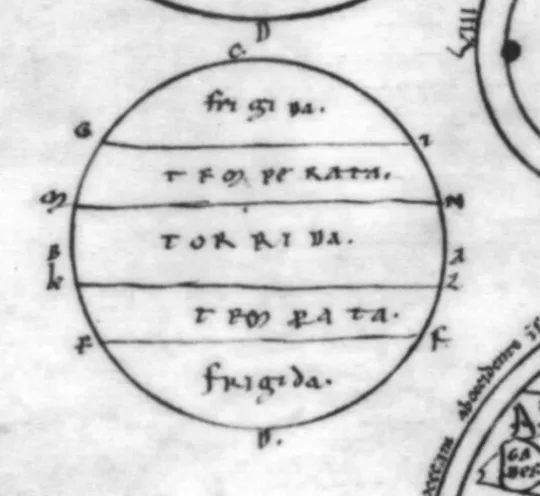
History is full of accidents. Here we have a remarkable example: the primary geographic model of the world for all of medieval Europe is traceable directly to a fictional dream sequence from ancient Rome!
Along with this model came our familiar torrid zone myth. It filtered down from scholars and monks to common people and Atlantic sailors. Medieval travelogues described Africans spending their entire days submerged in water, but for their faces, to avoid the heat of the sun. The torrid zone became a great barrier, the stuff of legends, and by the 15th century no man was known to have sailed down the coast of Africa and returned.
III. The prince and the cape
The northern limit of the torrid zone shifted from author to author in classical times, but by the early 1400s Atlantic sailors understood the known world to end at Cape Bojador. This was for good reason. At this promontory, along the coast of what is now Western Sahara, the currents pick up and the prevailing winds turn sharply out towards the open ocean. To understand the kind of fear the Cape inspired, put yourself in the mind of a medieval sailor. Venturing many miles from Portugal, your head is likely filled with stories of the torrid zone. To your east you glimpse a endless landscape of sand dunes. Overhead is a blazing sun. Behind your sails, violent winds threaten to pull you out into the Atlantic, that utter oblivion. "Return before passing the Cape or never return at all," summarizes a contemporary proverb.
This was the psychic environment that awaited Prince Henry the Navigator (1394-1460), younger brother of King Edward of Portugal. For details on his life I lean heavily on Gomes Eannes de Azurara, Chief Chronicler of Portugal. Writing a few years later in the service of Afonso, Henry's nephew, Azurara is certainly admiring of the Prince:
"Let me say that this noble Prince was of a good height and stout frame, big and strong of limb...Strength of heart and keenness of mind were in him to a very excellent degree, and beyond comparison he was ambitious of achieving great and lofty deeds."
Flattering as he is, Azurara gives several justifiable reasons for Henry's drive to round the cape: religious zeal, a desire for trading partners, and even astrology. Curiously Azurara also cites Henry's desire to find more Christians in far-off lands to help in his wars against the Muslims - an implicit curiosity about the very Antipodeans whose existence was doubted by St. Augustine centuries earlier.
Whatever his reasons may be, Henry set his mind on rounding Cape Bojador:
"[Henry] had also a wish to know the land that lay beyond the isles of Canary and that Cape called Bojador, for that up to his time, neither by writings, nor by the memory of man, was known with any certainty the nature of the land beyond that Cape. Some said indeed that Saint Brandan had passed that way; and there was another tale of two galleys rounding the Cape, which never returned."
As Henry sought brave sailors to make the expedition, he came up short of his goal repeatedly. Voyage after voyage turned back, citing "the wide-spread and ancient rumour about this Cape," pleading with the Prince that no boat would ever return. "Beyond this Cape there is no race of men nor place of inhabitants," they said.
In 1433, a frustrated Henry knighted his squire, a man from Lagos named Gil Eannes, and sent him on yet another expedition. When he too turned back, the Prince admonished him. Grasping him by the shoulder, he says:
"...In truth I wonder much at the notion you have all taken on so uncertain a matter. For even if these [tales] that are reported had any authority, however small, I would not blame you, but you tell me only the opinions of four mariners, who come but from the Flanders trade or from some other ports ...and know nothing of the needle or sailing-chart."
Defiant, Henry calls into doubt the torrid zone, which had been taken as fact for centuries in Europe. Interestingly he holds up the compass and astral chart, relatively recent technologies in Europe, as reasons to doubt it. With what might be called proto-Renaissance reasoning, he calls out hearsay and rumors in favor of empiricism.
This is enough to steel Eannes' nerve and, at long last, he successfully navigates past the Cape in 1434. But when it came time to return home, Eannes needed a healthy dose of courage. It turns out that the trick to returning home past Cape Bojador is in theory simple, though it requires great resolve. A ship needs to bear west, out into the open ocean, until the sails catch the westerlies. These winds prevail to the northwest and allow the sailor to loop back around to the north, a maneuver the Portuguese would come to call the volta:
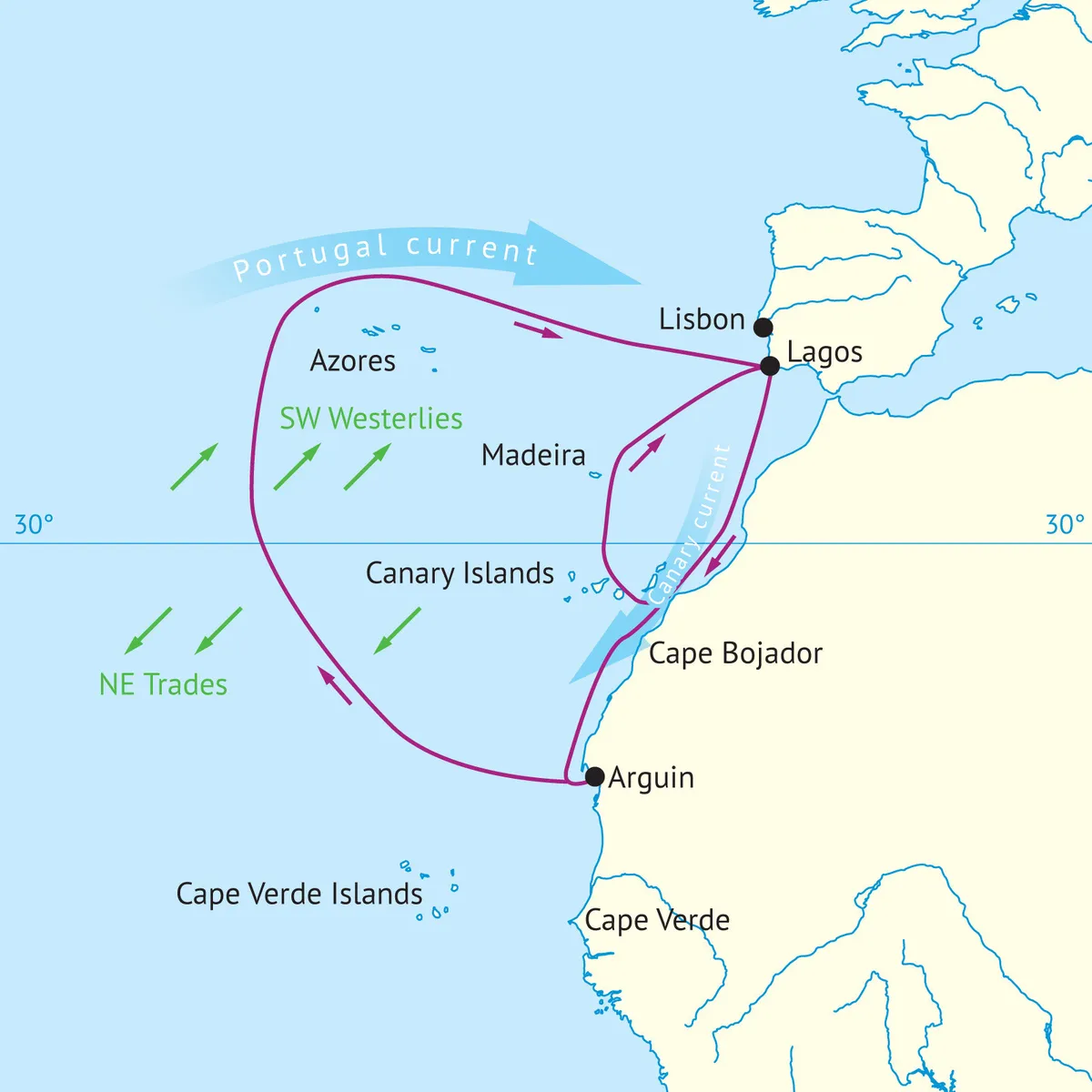
We are unsure of the specifics of Eannes' route, but he did return to Portugal to a delighted Prince Henry. From his first voyage, he brought back a handful of reddish herbs from the shore. From his second, he brought back something even more remarkable. Gil Eannes, first European to brave the torrid zone, returned with incredible news: he saw "footmarks of men and camels."
IV. Marginalia
Let's return at last to Columbus. If you were to walk into the Biblioteca Colombina and ask to see his copy of d'Ailly's Imago Mundi, you would find, as I mentioned, a reference to the "uninhabitable" torrid zone. But in the margin, scribbled in Columbus' hand, you would see a note:
"It is not uninhabitable, because the Portuguese sail through it nowadays, and it is, indeed, very thickly inhabited."4
Thus with one voyage, Henry the Navigator and Gil Eannes shattered a 1700-year-old myth. By action and stubbornness they defied conventional wisdom which had limited European exploration for centuries. What's more, the technologies that enabled better navigation of the Atlantic - like the compass - were available to the Portuguese at least a century earlier. As French historian Fernand Braudel notes, technology defines the ceiling of human achievement, not its actuality. The real deterrent to exploration was primarily mental - reinforced, we might say, by mimesis.
Cicero wrote the Dream of Scipio to console himself about the smallness of Roman affairs on a cosmic scale. It was his meditation on humility in the face of universe much larger than us. But the cruel irony is that the dream he imagined would convince Europeans for over a millennium that vast portions of the Earth were forever beyond reach. Today, how many other truths are waiting to be written in the margins of our inherited certainties? Ask yourself: are there footprints in the sand, waiting to be found?